Bagshot Park
There has been a Royal hunting lodge on the site now known as Bagshot Park for many centuries: it was well favoured by the Stuart kings. Later it was used by various officers of the Royal household.
Bagshot Park again became a Royal residence in the 19th century. During the early 1800's it was the home of the Duke and Duchess of Gloucester and enlarged (and presumably restored for it had also fallen into a poor state of repair) after a plan by John Nash.
Daniel provides some detail: Queen Victoria's aunt, third and last surviving daughter of George III, The Princess Mary, Duchess of Gloucester (1776-1857) made Bagshot her home upon her marriage to her first-cousin, William Frederick, Duke of Gloucester (1776-1834) in 1816. The Duchess lived in the home, and at Gloucester House, Park Lane, until her death in 1857. A quick reference on this point is Flora Fraser's 'Princesses: the six daughters of George III'. 570.
Christopher Warwick has clarified that Flora Fraser is the daughter of Lady Antonia Fraser and granddaughter of the late Earl and Countess of Longford; the latter being the celebrated writer and historian, Elizabeth Longford and not Lady Flora Fraser, the 21st Lady Saltoun, widow of the Duke of Connaught's grandson Captain Alexander Ramsay of Mar as I had mistakingly assumed. 6141.1206
 In 1875 Queen Victoria had a
new house built on the estate for her third son, Prince Arthur, Duke of Connaught
upon his marriage. One correspondent has suggested that the architect
was Benjamin Ferrey (1810-1880). The original building being demolished
in 1878. The Duke lived there on-and-off until his death in 1942. 8080.1008
In 1875 Queen Victoria had a
new house built on the estate for her third son, Prince Arthur, Duke of Connaught
upon his marriage. One correspondent has suggested that the architect
was Benjamin Ferrey (1810-1880). The original building being demolished
in 1878. The Duke lived there on-and-off until his death in 1942. 8080.1008
All that can be seen of the park from the road is the entrance drive and the lodge, shown on the right here. The park is not open to the public. Though glimpses of the main house can be seen from other places.

Adrian tells us that a 1927 photo of Bagshot Park house can be seen here.
It is interesting to note that neither Duke actually owned Bagshot
Park, it remained Crown property and presumably its occupants were
tenants. The Duke of Gloucester, though, did buy various pieces of
neighbouring land between the estate and Sunningdale.
Army Chaplains
For about 50 years following the end of the WW2 the buildings were used as the centre for the Royal Army Chaplains' Department.
Several people have written warmly of the time they spent on courses run by the Chaplains, including Norma Berendt "I spent two glorious weeks in 1978 at Bagshot doing a military religious course, it was wonderful . Our pardre Father Tom Kelly was an angel. A wonderful house and lots of corridors. The gardens were a huge treat for a wee girl from the Glasgow tenement flats. So any pics or anything to do with the house and garden also the surrounding area are a pleasure " [645.0308 + Oct 12]
Ian : "I was very fortunate to spend a week in the house in 1985 when it was the "home" of the British Army's Chaplains Head Quarters. I was impressed by the grandeur of the building - quite grand but very homely. It had a lovely intimate feel to the place.".[Feb 12 XXX].
The story I like best is of a sign placed by the ornamental ponds 'please do not walk on the water'.
Tricia has written "I lived in Bagshot Park from 1954-57 and over the years continued to go back there for functions or simply to visit. I was also the first person to get married in the chapel. I explored the house and gardens and knew and loved it all so much. My father, The Very Rev. I D Neill, later Chaplain General, was the Warden at the park and responsible for running the courses etc. which were held there."[Jun 15]
Chris Arey (nee Taylor) : I lived in the park in the early 70s, firstly in Smithers Cottage then Head Gardeners Cottage. My dad was chauffeur to the Chaplin General and my mum worked in the house . Names I remember include Mrs Ghost and Rev Dougal. My sister got married in the chapel. [May 17]
Dan : I have many fond memories visiting the house at least once a year as an army chaplain from 1973 until our lease ran out about 1996. The India room is magnificent, the ceiling is actually of carved wood geometric panels. The V&A museum website has some pictures of the room and an ornate chair www.vam.ac.uk/articles/the-bagshot-park-chair. [Sep 17]
Dan has also provided two photos showing the magnificant fireplace in the hallway, in use here as a briefing room.

Tommo : I have fond memories of Bagshot Park. I served there from 1984 to 1988 in the ACC. I was the only live-in soldier and spent many a night as part of my 'Guard Duties' in the house doing patrols. There was a night watchman called 'Sam' and spent hours listening to his stories along with his Jack Russell. I met my wife at the time while serving there as she was based in the lower farm building offices. We were kindly given the park, House and gorgeous chapel for our wedding in 1987 and married by the Padre who was living in the house attached to the main house. He use to let me use his garage in the courtyard to store my old car. I remember playing snooker in the Indian room library,exploring the cellar and upper roof areas and bell tower and finding the secret panels that led between the inner walls of the house. I also served the garden Party on 30th July 1985 for the Royal Mail Celebration as it started at Bagshot Park on the old house. Lady Diana and Prince Charles were in attendance. [Sep 20]

During the Duke's time the grounds of the estate were used from time to time as a venue for major local events, a practice that continued during the Chaplain's occupancy. An example, as mentioned by Tommo above, being the Royal Mail celebration of the 350th anniversary of Charles I's signing of the Charter that established the postal service.
Bagshot Park again became a Royal residence at the turn of the century. Prince Edward, Earl of Wessex, married Miss Sophie Rhys-Jones in 1999 and they moved into Bagshot Park not long after. Prince Edward was given the title Duke of Edinburgh in 2023. He is our late Queen's third, and youngest, son and brother to King Charles III.
 Most of
the estate is used as a farm, I assume let by Crown Estates to a tenant
farmer.
Most of
the estate is used as a farm, I assume let by Crown Estates to a tenant
farmer.
The building shown in this illustration is the old house as it was when it was home to Vice Admiral Augustus Keppel, circa 1790.
For those interested in Bagshot Park's origins, there is information included in the book "The Queen's Knight" by Martyn Downer, the story of Howard Elphinstone - Governor to Queen Victoria's son Prince Arthur (later the Duke of Connaught.) Re David's note about Prince Arthur's clothing : this book mentions that he was made to wear a kilt until the age of 16, when he was allowed to wear a tailcoat & top hat for the first time - for his confirmation.
Indian Room
Within the house there is an ornate room (or perhaps a room and a corridor) known as the Indian Room. Chris writes that she has been reading "A Circle of Sisters" by Judith Flanders which describes how the Duke of Connaught, when visiting India, met Lockwood Kipling (the father of Rudyard) who was a notable designer and art educator. The Duke asked him to design some rooms in the indian style, including a billiard room, for Bagshot Park. They were made in India, ready to be assembled in Surrey. ref601
Suki adds : When my daughter was doing a history project about Bagshot Park in about 1990, we were very fortunate to have a guided tour of the building by the Officer in charge. He told us that the beautiful carvings, done in India, were installed by two Indian workmen, who spent two years completing the task. They were accommodated in a tent in the grounds! 6102.1006
Wendy writes that a book was published in 1986 by the Royal Army Chaplains Department that included photos of the Indian corridor, Chapel and Indian (billiard) room. During the period that it was used by the Chaplains occasional tours were possible and Wendy recalls going on one such tour with the local history group. There is also a booklet, put together mainly extracts from the Surrey Advertiser, by the Local History Society on The Duke Of Connaught's Bagshot 1880-1889. 220.906 220.404
The booklet "The Duke Of Connaught's Bagshot 1880-1889" that Wendy refers to is available from Surrey Heath Museum.
Bill, who worked in the stable offices as Staff Assistant to the Chaplain General for 2 years before retiring from the Army in 1987, confims that the book contains pictures of the great sculptured wood fireplace, the Indian hallway and many more internal and external views as well as a detailed history of the main building. [Nov 13]
Rapley Lake
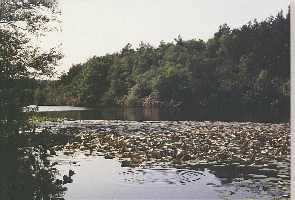 Rapley
Lake is one of the beautiful features of the original, larger, estate.
(location)
Rapley
Lake is one of the beautiful features of the original, larger, estate.
(location)
How, and when, did it get its name is the intriguing question posed by Martin Rapley who recounts that in the 18th century there were some rogues in the Surrey area called the Rapley gang.
No sooner had I published this enquiry that I received: I am another Martin Rapley and I have been to Rapley Lake. I wondered how the lake got its name. Its interesting to hear about the Rapley Gang, they must be related to me.
Ron Frost wrote to add that during WWII the Canadian Army had a base in Bagshot Park and used Rapley Lake for boat drill. After the war the 1st Bagshot Scout troop held week-end camps there. In 1947 one of the Canadian Army huts was transferred to an old quarry ground off Waverley Road by the scouts themselves and they used it for many years. [612.0106]
Teresa writes: I remember jumping into Rapley Lake when I was about 4 years old. I eventually came up gasping and spluttering. I was too young to realise that the boys in our picnic party were taller, older, and, better still, they could swim !!!!! [7021.307]
John Rapley asks: What about Rapley Farm which is shown close to the lake on the OS map. [7016.207]
Allend provides a convincing answer as to whether Rapley Lake or Rapley Farm was named first: I have a copy of the Timeline Historic Maps series sheet 175 (which matches modern OS Grid and I highly recommend). the map includes Bagshot (and the blank area where Camberley will be) and was original published in 1817. It does not explicitly name Rapley Lake, but the adjacent farm is designated "Heatley or Rapley's F." [661.507]
Detailed examination of the 19C map and comparison with recent 1:25000 maps enables many features to be correlated, including many of the Bagshot Park boundaries and drives, two smaller lakes on the estate, and Rapley Farm. Interestingly the county boundary is in a slightly different place. Significantly Rapley Lake is not shown. The outflow of the lake and much of its southern edge is banked in a manner that has always suggested to me that it is man-made, so we may conclude that the lake was constructed some time after the map was drawn. While the map was published in 1816, the date of the survey is not known and could have been at any time from 1791. The lake does appear on an 1876 map.Rapley Lake was presumably named after Rapley Farm. So now our questions are 'when was Rapley Lake constructed?' and 'where did the name Rapley come from for the farm?'. Could the answer be as simple as 'the farm was owned by Mr Rapley in the mid-1700s having previously been owned by Mr Heatly?
Carol Mavin : My great great grandparents James and Mary Ann Cranston occupied Rapley Farm from September 1849 until September 1851. They were working 600 acres. James had previously worked as Land steward at Lanrick Castle in Scotland. I would be interested to know what relationship the farm would have had to Bagshot and Queen Victoria and Prince Albert. The Cranstons came to Australia visiting first Adelaide and then settling in Melbourne and spending some 9 years on the gold fields managing to have 9 children of whom all survived. [Aug 17]
Neil provides a connetion: Prince
Albert purchased the farm and stocked the grounds with 2000 black faced
grouse that were donated from a friend's Scottish estate, unfortunately
they need moor land to survive and most of them perished in the first
year, however Albert did use the area as a personal hunting ground when
staying at Windsor.
There
is a record of a white tailed eagle being shot on the farm by a keeper
in the 1870’s, however it was originally reported as being a golden
eagle which caused quite a stir. A 35 pound pike was also recorded from
the lake in the late 1800’s [Dec 17]
Lionel Parr recalls when Rapley and the other lakes (except for Stone Bridge Lake) were drained during the war, in a bid to make aerial navigation by the Luftwaffe more difficult. Rapley lake had a cast iron gate valve for draining, although there is no indication of when it was orginally installed. In one place there was also a concrete wall with pieces of board nailed into it. Lionel speculates that there may at some stage have been a small water wheel to drive a saw for cutting timber. Certainly until the 1940s there was a sawbench near the lake. [Nov08]
Linda Stubbington discusses Rapley as a local family name in our 'people' section.
I describe a pleasant walk to Rapley Lake.
Please use the message pad below to reply or to add anything to this site.
Staff in service at Bagshot Park
It appears that negligible information is available from official archives about staff who were in Royal service in Bagshot Park. Adrian tells us: There is at least some information available in the Royal Archives about people who were "in service" (as domestic staff, gardeners and the like) in Royal households. Based on a personal enquiry some years ago, I believe there is relatively little about those employed at Bagshot Park.
Find-My-Past have put on line various records of Royal Household Staff covering the period 1526-1924. You can search for free but downloading details will cost - alternativerly many libraries have subscriptions to FMP that you can use without charge. Given Adrain's experience, which has been confirmed by several other correspondents, it would be unwise to be too optimistic - but it is always worth a try.
There was a large staff during the Duke's occupation. The 1881 census records an Equerry and 26 servants living in the main house (an under butler, a housekeeper, 4 valets, 2 lady's maids, 2 dressers, a cook, 3 kitchen maids, 3 housemaids, 3 footmen, a page, a porter, a scullery maid, two other junior posts and a soldier!). A coachman and 7 grooms lived in the stables. Two other domestic staff lived in one of the lodges, 3 agricultural workers lived in another, and one gardener is recorded as living on the estate. There must also have been at least a butler, and presumably further gardeners and groundsmen who lived off the estate.
From Davina : I too have thought it strange that the butler did not live in. Maybe he had been called away on that night. [218.906]
From Charles:My grandfather Henri Cedard was Chef des cuisines to HRH the Duke of Connaught from 1885 to 1898. He went with him to India, and married the Duchess's first chambermaid Elizabeth Wigg in 1891. Cedard went on to become Chief Chef to The Prince of Wales, later King George V. I should be extremely grateful for any details concerning him. [May 20]
Clements enquiry
from James
I am interested in
making contact with anyone with information
about the staff at Bagshot Park - I have connections with the Clements,
Parker, Ward & Baldwin families): My 3 x great grandfather
James Clements (b.1845) was employed (possibly as a groundsman) for 50
years on the Duke of Connaught's Estate. He married Emma Taylor
& they had 11 children. Their son James Clements (b.1876)
married Louisa Parker. Another son Harry Clements (b.1873) was a
building contractor in Bagshot, married Kate Dukes & they had 5
children - their only son Bert Clements (1903-1965 Bagshot) married
Annie Jordan whose younger daughter Sheila Clements (1929-1982) married
Fred D Baldwin (d.1968 Bagshot). I would be grateful for information
about any of these families, particularly in connection to Bagshot Park.
[Apr 15]
From Roy Koerner : [Feb
12]
The soldier listed
on the staff of Bagshot Park in
1881 was Ernest Koerner who was my g/g/grandfather's brother. He gave
his birthplace as Heligoland - at the time a British island in the
North Sea off the German coast. However this is incorrect as he was
actually born in Sindelfingen in the Kingdom of Wuerttemberg in
southern Germany. His three older brothers had all migrated to England
in the 1860s and were living in Sheffield. They all had allegedly come
to England to avoid conscription into the German army, so it is a bit
of a surprise to find Ernest in the Rifle Brigade of the British army.
As a German he presumably would have had difficulties in enlisting and
he therefore concocted the story about being born in Heligoland which
was British until it was exchanged with Germany for Zanzibar in 1891.
I have often wondered how a mere rifleman whose English may not have been very good came to be on the household staff of the Duke of Connaught. I assume he was there to provide protection for the Duchess, being able to speak to her in her own language. However as a speaker of classical Hanoverian German, she may not have been able to have understood his strong Swabian accent too well !
From Dave : My father was Head Coachman to the Duke of Connaught and lived in Coachmans house on the estate until his death in 1967. I myself was brought up in the Park and spent many a happy hour on my trike going around the many paths and drives. After the Duke died in 1942 my father was employed as a gardner and in his later years was employed in the house as a "General factotum"! Many times I went with him to work as a child and I got to know all the corridors and narrow staircases that existed. One part of the house that was fascinating was the chapel with many artifacts kept in there. In his later years my father always rang the bell for the services. His name was John Ghost so you can imagine the comments about "a ghost tolling the bell"! [233.907] Peggy writes that she remembers Dave's father "He was known as Pop Ghost and helped me with my daily chores when I was working there between 1940-1942. I also went to his wedding." Nov10
From Marianne : When we lived in Bagshot Park I remember Mr and Mrs Ghost they lived in a house at Home Farm, also Mr and Mrs White they had 3 children I think. Mr White was a chaplain. [Jan 18]
Mary wrote : My Great Grandfather , Charles Walter Draper, worked at Bagshot Park House and appeared on the 1891 Census as a Porter. He was 31 at the time and his wife and 5 children lived in Bagshot Square at the same time. I wonder if it was him that was at John Gatfields wedding?. (see below) [7081.1107 x] Davina has been able to confirm: It is indeed Charles Draper who was best man or witness at the wedding of my great-grandparents. I wonder at their relationship as my John Gatfield was certainly an outside worker and Charles worked in the house. They must have known each other from the village. My great-grandmother also worked at Bagshot Park and while I had ideas that maybe she was a parlour maid I would imagine she was an outside worker as well. [Mar 09]
Rita has written: My late mother-in-law Florence Baldwin (as she was then) was for several years 'in service' with the family, accompanying them on their visits to Blair Atholl. I think this was prior to WWI and perhaps during the war too. These seem to have been happy times. If only we had found out more about her experiences during her lifetime. [6116.1006]
Ray Healey has written: My wife's grandfather, Karl Schwarck (born 1857 at Doberan, East Germany) came to England in about 1880 with his wife Katharine (born 1855 DEU Germany) and was employed as a valet to the Duke of Connaught. Later he became a butler and/or equerry, remaining in the Duke's service until about 1920. His wife ran a guest house in Battersea. At the time of WW1 they Anglicised their surname to Swark. They had two sons and a daughter. Does anybody has any more information about Karl Schwark, especially during his time at Bagshot Park.. [447.107]
Chris Howard writes: "I was fortunate enough to be allowed to get married at Bagshot Park in 1983 whilst serving at the house in the Army Catering Corps." [8007.108]
From Alison : My great grandmother met her first husband when they both worked on the estate together. My grandmothers name was Laura Mary Gosden and her husband was Jack Davis. I have two pictures of my grandmother along with other staff in service at Bashot Park during that time. I think she was a nanny or nurse maid. [8026.408 x]
Bernard writes: I have in my posession a silver inkwell & stand engraved with the message "presented to Robert C Burne by T.R.H Duke and Duchess of Connaught Xmas 1900", Robert C Burne was my grandfather, but unfortunately I know little about him. Does anyone have any records of landagents employed by the Duke of Connaught. {Oct 07}
Janice writes: My great uncle, Thomas R Clarke, worked at Clarence House and Bagshot Park, first as a pantry boy progressing to valet and butler. He traveled with the Connaught family to quite a lot of places abroad. In 1941 his last letter to my family (posted from Freemantle) was to say he had been ill and was going to Australia to rest. He was never heard from again. I am the third generation looking for him. As far as I know he was working for Princess Pat & family. I have some photos of his days in service. I would be grateful for any information,or contact with anyone who has heard of him. I have papers to prove he was with the family from age18 years to his disapperance aged 40. [9024 Feb09]
Janet writes: My Great Grandmother, Sarah Price, nee Curtis, worked at Bagshot Park. She was a wet nurse for the Princess Margaret (Daisy). I have a photo taken with the baby at Balleter and another in her uniform on the Isle Of Wight. [May09]
Donna Baxter contributed:
My grandad was the body guard of the Duke of Connaught and lived at Sunningdale Lodge until his death in his nineties. His name was Wallis or Edwin Francis, he had two daughters, Vera and Daphne, I am Daphne's daughter born in Canada near London, Ontario.
My grandad served with the Duke in India, where he met my grandmother Celina. My mom was born in Gibraltar, but was raised at Sunningdale Lodge. [9045 vii9]
Iain asks: Does anyone have knowledge of a Charlotte Haskins (sometimes misspelt Hoskins) who was nurse to the Duke of Connaught in the 20's/30's and 40's? Jan10
The late Lionel Parr, who worked at Bagshot Park, wrote in 2014 "I recall the Duke being driven around the Bagshot Park estate in an Austin by Miss Haskins. I think (more than 70 years later) that it was brown or green." [Jan 14]Frank Davies writes "I collect medals and have a group to 4854 Private G. Boxall who served in the Boer War 1899-1902 in Transvaal and later, certainly in the 1930's, became Estate Carpenter at Bagshot Park. Does anyone have any further information on this gentleman please." Apr10
Liz Johnson takes us back before the time of the Duke of Connaught: "My great great great grandfather Richard Wickens was a builder and lived in the Park with his wife Rebecca and daugher Mary Ann who married my great great grandfather Henry Hammond who was a gardener at Bagshot - they are all on the 1841 census. In 1851 census Rebecca is still there on an annuity." {Apr 11}
Jeanne writes: I have information from my family that an ancestor of mine Herbert Edward J Phillips (known as Eddy) was a valet to the Duke of Connaught until his death in 1942. I would love to hear from someone who worked with/knew him. [Aug 11]
Les writes: In the 1911 census of Bagshot Park 'my' George MURTON was recorded as one of 3 valets who were listed as "visitor". I can only find two Gentlemen listed as visitors - on the same page as HRH Duke of Connaught - Count Alexander HOYER & Louis De Pan MALLET. Assuming that a Gentleman would bring one valet with him there is a spare visiting valet. Can anyone suggest a reason for this? I cannot trace George in the 1901 census. [Aug 11]
Jill Whitall tells us: My great grandfather, Grampy Higgs, was a gatekeeper at Bagshot Park (the gate nearest Bagshot Village) when the Duke of Connaught was there. He lived off site in Church Road. [Jan12]
Joan contributed: My grandma, who was born 1880 in Inverness and known as Maggie Macdonald, worked at Bagshot Park and one of her duties was to iron all Princess Patricia's gowns. Years later grandma, with my mum, would visit the house and play tennis with the staff. Also my mum remembers playing "hide and seek" with Alexander son of Princess Patricia and Alexander Ramsey. [Dec 11 X]
Kim writes : My Grandfather Fred Parker's funeral service was held at the chapel in Bagshot Park as F. Parker and son had a royal warrant for supplying the crown and also his fiancée Doris Halliday was one of the staff at Bagshot Park at the time which facilitated their meeting [Dec 12]
Dauna Harrold writes : My great great grandmother, Pauline Borel, worked as a lady's maid to the Duchess of Connaught sometime between 1881 and 1885. She was born in Neuchatel, Switzerland around 1866 and gained employment through an agency in London when she was in her teens. She travelled with them around the world, including to India and maybe South Africa. She was present on 14th July 1884 when the Duchess planted a tree in Connaught Park, Dover. This may have been where she met her future husband, Herbert Freeman Brown. They married in September 1885 and lived in Dover. the duchess often gave small gifts of silver jugs or plates to Pauline as a thank you for her work. [May14]
John : I
had always heard that my great great
grandfather, Jonathan Hutton, was coachman to Prince Arthur, Duke of
Connaught at Bagshot Park, though recent reseach suggests that he was
more likely to be indoor staff, perhaps an under butler.. This was
likely in the mid nineteenth
century, but I do not at all know the precise dates. His grandson, my
grandfather, emigrated to the United States. [Mar
14 XXXX]
Subsequent to posting this, John has discovered that in 1891 his
forebear was butler to Lady
Elphinstone,
residing at Pinewood, College Ride. Lady Elphinstone was the
widow of Sir Howard Elphinstone, equerry to the Duke and who had died
the previous year, so it is possible that he may have previously worked
for the Duke, though it is probably more likely that this is an example
of oral family history getting a little distorted. In 1881 Jonathan had
been a civilian in the officer's mess at Aldershot. [Oct 18]
Bagshot Park staff who are mentioned elsewhere include: Edward Cox.
Gardeners
The Head Gardener from 1928 till the time of the Duke's death was John H Parr (1890 - 1979). He was preceded by Charles William Knowles (1857-1941) who worked at Bagshot Park from about 1903 until 1927. Before that the Head Gardener was John Burden.


(1) the Head Gardener's house. (2) another gardener's house.
The houses had the postal address: The Gardens, Bagshot Park
A 1927 photo can be seen here . In addition to these houses with the Park, I have heard claims that two properties across the A30 from the park were homes of Head Gardeners, or perhaps retired head gardeners. One is a cottage, long since demolished, in the vicinity of the old police station, the other a large house built about 1890 and known as Pantiles House. However I have also heard it claimed that the latter was built for the personal secretary of the Duke of Connaught.
Davina writes "My great grandfather, John Gatfield, was a gardener on the Bagshot Park estate and it was there that he met his wife. He did not live on the estate and is to be found in Bagshot village at the time of the 1881 census. My great grandmother was working on a farm elsewhere; they were married in 1886. One of the staff who is actually listed as working and living in the house as a porter was Best Man at their wedding. [218.906]
"Another gardener who has been mentuioned is Henry Hammond who appears to have been a journeyman gardener at Bagshor Park, and then moved on to get promotion. A gardener's progression would be something like garden boy (prob age 13 on leaving school), third journeyman, second journeyman, first journeyman, and then on to more senior positions. The Head Gardener at Bagshot Park would likely have proven his capabilities in a similar role at other places before getting a prestigious position such as Bagshot Park." [iii01]
Jeanette Dale writes: My grandfather was Thomas Matcham who worked at Bagshot Park and lived in one of the gardeners houses. I spent my early years in the 1970's there as both my parents worked with my grandfather. We had 2 donkeys called Chelsea and Derek, one of them used to escape and the police station across the road used to bring it back. My grandfather employed lots of different people and I am delighted to see Robert Allen remembered him. Sadly my grandfather passed away some 10 years ago. [Jan12]
Staff acquisitions.
It seems that it was not uncommon for staff to be given gifts from their employer's possessions, one example being described on another page.
David has written with another story: [6137.1206]
My grandmother was Elsie Styring nee Riddle (b.1885 in Cornwall d.1974 in Sheffield). She married my grandfather, Henry Styring in 1912. He was a serving soldier (enlisted 1909) with the Sherwood Foresters. She had spent her teenage years in service and I believe she continued to do so after marriage. She had some garments which were reputed to have been given to he when in service. They were a very formal military-type waist-length velvet jacket and a plaid waistcoat. She said they once belonged to the Duke of Connaught when he was a boy.I remember that these garments were clearly handmade and looked as if they were meant to be worn over a kilt. In the 1970's, after my grandmother's death, I handing them to a so-called expert for verification. She stole them and neither she nor the clothes have been seen since. Is it likely that they could have been genuine? If so, to which Duke of Connaught would they have belonged?
Another reader tells us : For those interested in Bagshot Park's origins, there is information included in the book "The Queen's Knight" by Martyn Downer, the story of Howard Elphinstone - Governor to Queen Victoria's son Prince Arthur (later the Duke of Connaught.) Re David's note about Prince Arthur's clothing : this book mentions that he was made to wear a kilt until the age of 16, when he was allowed to wear a tailcoat & top hat for the first time - for his confirmation. [9004.i9]
Evacuees
Jean writes that her two sisters were evacuated to Bagshot during the war. They recall a sweeping drive with conifers and cones on the ground, and a large hall with a wooden floor. The staff all wore uniforms like nurses. Would this have been Bagshot Park. Do you know whether Bagshot Park was used for such purposes? [7069.907]
Peggy Gibson (nee Lovell) confirms that evacuees were housed at Bagshot Park: I worked at Bagshot Park between June 1940-1942. I worked in the stables where child evacuees from London were looked after. I trained to be a nursery nurse during that time. I've already been very fortunate to have got in touch with Crown Estates and been shown around the estate before Prince Edwards took over. I would be very happy to answer more questions on the history of the estate and war time years. I also have photos. [Oct10]
David adds: "It would appear that Peggy Gibson (nee Lovell) would have known my mother, Daisy Brown who married my father John Ghost who lived in the Coachmans House next door to the stables where the nursery was. We lived in the house until 1967. Also Diana's great uncle would appear to have lived in the same courtyard as I did (although not at the same time). A picture postcard of the yard appears on Frith cards website." [Oct 12]
WRNS
Rose writes from Australia: I
am trying to find out
more about the WRNS at Bagshot Park during WWII. My mum was based
there. I would like to know more of the day to day workings and if
anyone recalls Rose Hendry (married to ? Gerrard - unsure when) DOB
04/08/1926 born Port Glasgow Scotland. I am doing our family tree and
mum passed away a few years ago. .
Subsequently Rose added I have since recieved some Photos of
my Mum at the fishpond in Bagshot park, she is in her WRNS uniform and
with some mates ( 6 or7) this was in 1948. So perhaps she was not there
during the war. I would still like to hear from anyone whom may have
been there at the same time. She was a bit of a character joking with
the chaplians etc. But I suppose being around 21yrs a bunch of young
lassies were making the most of their times.. [8022.308.508]
Ornate Ceilings
Carol wrote from Canada : An ancestor is said to have worked at the building of Bagshot Park in Queen Victoria's day, making decorative ceilings and asked where she could learn more about this and whether there are any web sites showing pictures of such ceilings. She also discussed whether this person may have been a builder called Boyce . [442] Unfortunately I no longer have a contact address for the original enquirer, which is a shame because more recently I have had a message from Tim Cooper who writes "I too have an ancester called Boyce who supposedly was a builder in Bagshot " - and I can't put them in contact with each other. [Sep 12]
I have no first hand knowledge of Bagshot Park's interior but there can be no doubt that the rooms will have had ornate plaster decorations on the ceiling - this was the style of the time. I believe that the process is that the decorations are cast in plaster either on-site or at a craftsman's workshop then "stuck up" on the ceiling into wet plaster. In an example of work I saw at a craft museum (albeit not local to here) the cast plaster decorative mouldings were reinforced with hessian within. Many craftsmen would have been employed doing the building work.
I know of no published pictures of the ceilings in Bagshot Park, but I would guess that the web site of the National Trust (a UK organisation who own and maintain many old properties) will have pictures from other 'stately homes' that will illustrate the general style of decoration. I would be very doubtful as to whether you will be able to track down just who worked on the building.
Though not related to those at Bagshot Park, Claude wrote to tell us about Indian ceilings
If you wish to see another example of an 'Indian' ceiling in Britain, look at the Osbourne House site of English Heritage. Lockwood Kipling went on to design the Durbar Room there, when Queen Victoria wanted to celebrate her being made Empress of India. However, having been to India and having seen original examples, the English versions are not as impressive! In India, the ceilings would have been made of Marble*. The Osbourne ceilings are made of fibrous plaster.
* True Indian marble work can be seen at the new Hindu temple in Neasden, NW London. [8053.508]
Can you add anything? Use the message pad below to reply.
Jon writes: My grandmother lived in the gatehouse (Sunningdale Lodge) pictured on your site in the late 70s and early 80s, with her husband, who was employed by the Chaplain's dept. I can well remember visiting them, usually on Sundays, and walking in the park and round the fishpond. The park felt quite spooky, having one or two unexpected follies in the paths, and some walk-ways through bushes. Once we were shown into the entrance rooms of the house - it was quite dark and felt cold. Following the death of her husband my grandmother left and moved to family in Wiltshire. Entirely co-incidentally, I now live nearby often pass the lodge. [8012.208]
Mike wrote from NZ: During
the mid 1960s my family lived at the old police station on the main
road in Bagshot. I went to school with David, the son of the commandant
of Bagshot Park. I well remember a whole bunch of us "hanging out" in
the grounds, particularly the old Ice House and the lake.
I also remember being shown round the house, particularly the Indian
rooms and although I don't clearly remember the details, I do remember
being awestruck. [8032.408]
From another correspondent : There
was a fantastic
wooden carved surround around the fire place in the main lobby, if that
is what it would be called. I spent
a week at Bagshot Park sometime around 1993-4 with Padre Grant Ashton,
a Blackburn Rovers fan! We were brought a cup of tea in bed each
morning, and I was blamed for eating over forty yoghurts one night when
I came back drunk from a night on the tiles. I still maintain that I
was innocent, it was nothing to do with me, and somehow I think the
Padre believed me. The sign was still near the pond then, and we were
taken into the secret garden with the wrought iron crown that had only
been recently discovered in a mass of rhododendron.
I really enjoyed my time there, I only ever saw Padre Ashton one more
time, in Croatia in 1995, and despite trying to get back in touch with
him I never have. I hear he went quite high up in the ranks, not sure
if he is still in the Army though or not. Maybe he'll see this message
and remember me. [8029.508]
Padre Grant Ashton did indeed see this and wrote: I remember the yoghurt incident - but not as much as I remember Croatia. PDC, where we were based, was an appalling place. I'm still serving, reasonably senior now, and contactable via HQ LF in Andover. {Apr 11}
Estate Properties
Several of the houses on the estate are now let out. Olly writes from the US "After the Chaplains moved out of Bagshot Park and before Prince Edward moved in the house was managed by Knight Frank, the real estate company. They placed a number of rugby players from London Scottish as security. I lived there for nearly 2 years in Station Lodge and a short period of time in Smith's Cottage and then the Head Gardener's cottage." [xi8]
One of my correspondents wrote wondering whether there was any connection between Bagshot Park and Longleat in the mid-1800's prior to the Duke's occupation.
Diana writes : My great uncle John Shawyer was the Stud Groom living at Stables Lodge in 1911 and I wonder if anyone knows anything about this lodge, or has a picture of it. [vii9]
From Victoria Huddleston "One of my mother's relatives was Barbara Stevens. She married Sir James Clark, who became physician to Queen Victoria. He was given the use of Bagshot Park for life when he retired, 1860, I think. He died there aged 81 in 1870. Jan13
Sale
Bagshot Park was, and remains, Crown property, however, following the deah of the Duke many of the contents were sold off. The BBC TV programme Antiques Roadshow first broadcast on 26 October 2014 included an exquisite French bronze statuette that had been bought by its present owner's grandmother. The particular bronze was by St Marceaux and dated 1879. It was valued at £3-5000. The programme was series 37 programme 7 but unfortunately BBC programmes are only available for a limited time on iPlayer.
| more about Bagshot | about the Duke of Connaught | an encyclopedia entry about Bagshot Park |
Many of my pages have been prompted by, or include questions or information from, my readers. If you can add anything to the above please write to me using the message pad below.
This page is part of the Bagshot
village web site.
back
Please note: My site has no connection with the
Crown Estates or any member of the Royal family, and I am not able
provide information about them, or forward messages to them.
Data provided only for personal background information. While every effort has been made to provide correct information no assurance as to its accuracy is given or implied. Check any facts you wish to rely upon.
Footnote.
The booklet refered to by
Wendy would be "Bagshot Park" compiled by